The Brain Doesn't Make Sense. And That's the Point
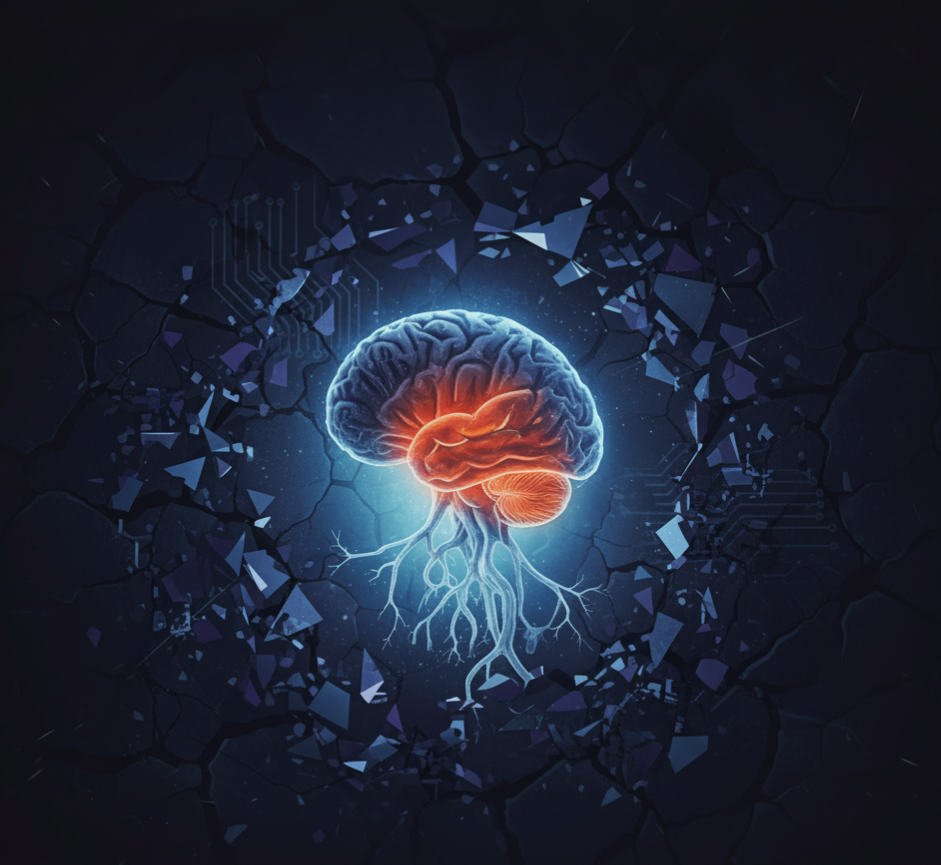
A brain structure has persisted for 500 million years across fish, amphibians, reptiles, birds, and mammals. The basal ganglia should tell us something fundamental about intelligence itself.
From a computational lens, it tells us nothing. Worse, it looks broken.
And that matters now, because we are building AI with that same computational lens. Every large language model, every reinforcement learning agent, every neural architecture runs on the God's eye view: someone outside the system who defines what counts as information, frames the problem, and specifies what success looks like. We have built machines that are extraordinarily powerful within that frame.
But we have not built machines that can operate without it.
If 500 million years of evolution converged on the basal ganglia, a brain structure that does not make sense within the computational, then we may be approaching the limits of what that computational lens can give us. Not just in neuroscience. In AI too.
For more about the limitations of computation: The Ultimate Hammer: Why Programmers Can't See Beyond Computation. A Dialogue.
The Lens We Inherited
Every computational system requires what we might call the God's eye view: someone standing outside who defines what information means, frames the problem space, sets the goals, and establishes what counts as true.
Even modern machine learning hasn't escaped this. We select training data, design architectures, specify loss functions. The God's eye view is pushed back one level — from explicit programming to implicit framing — but it remains.
This isn't just a technical assumption. It's a philosophical one, baked into how Western science thinks about mind: if persons are objects with properties, then intelligence is just computation with sufficient complexity.
The Absurd Architecture
The basal ganglia at its core is a disinhibition "mechanism", inhibition of inhibition. The thalamus is constantly suppressed. To allow action, the brain doesn't excite, it brakes the brake.
From the God's eye view, this is absurd. Why not simply activate what you want?
The standard computational answer: "action selection through competitive inhibition", secretly assumes a pre-defined action space, an external goal, a solution to the frame problem. It assumes the God's eye view is already in place.
But no one designed the organism. No programmer specified its goals. The basal ganglia has been conserved across 500 million years of creatures that had no external frame-setter.
What a Subsystem Can Actually Know
Here is the deeper point: a decentralized subsystem has no access to the God's eye view.
It cannot assert what is. To say "this is the correct action" requires knowing what "correct" means in the full context, and you cannot step outside yourself to see the whole.
It can only mark what is not. Through local history and lived interaction, it can detect failure. It can learn constraints. It can say: not this.
This is the basal ganglia's actual logic. Inhibition is epistemically honest. Excitation would be a lie, a claim to knowledge the subsystem doesn't have. Disinhibition is discovery: removing a learned constraint, clearing space, saying this is not known-to-be-wrong.
Action emerges not from positive command, but from the removal of vetoes.
So What?
The frame problem in simple terms is the question: how does a system know what's relevant? The frame problem has no computational solution. Every answer just pushes the question back one level further.
The basal ganglia doesn't solve it. It dissolves it, by abandoning the God's eye view entirely. No pre-defined action space. No external goal. No truth from outside. Just ongoing discovery of constraints from within.
This leaves us with a choice.
We can keep the computational lens and treat the brain as a poorly engineered program, one that evolution somehow botched by using double negatives where simple logic would do.
Or we can treat 500 million years of conservation as data, and ask whether the lens itself is the problem.
For AI, the stakes of that choice is apparent. We keep scaling systems that require more human framing, more curated data, more carefully specified reward functions, more God's eye view. And the systems that would need to operate without that external scaffold, in genuinely open environments, with genuinely novel problems, remain out of reach.
The basal ganglia suggests a different path. Not smarter optimization within the frame. A different relationship to the frame itself. Intelligence that learns what is not, rather than asserting what is. That discovers through negation. That acts from what remains possible after constraints are cleared, rather than from what was specified in advance.
Intelligence without the God's eye view doesn't compute. It inhibits. It constrains. It discovers through negation what remains possible — and acts from that remainder.
Not designed from outside. Emerged from within.
Our current models of intelligence can't account for that.